Skip to content
EPHEMERIS

00 / Aperture

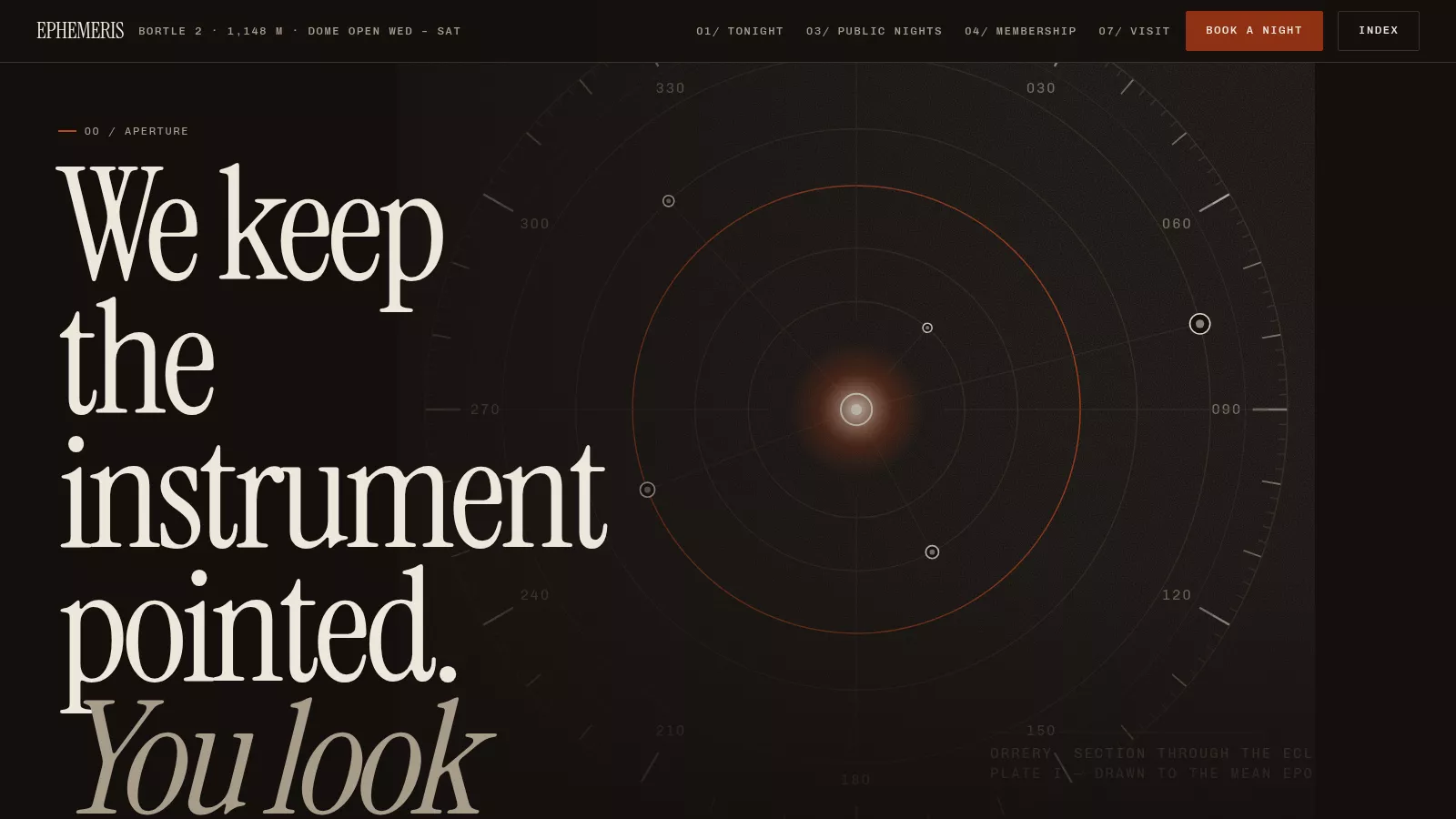
We keep the instrument pointed. You look through it.

Mechanism advance — orbital rates geared to sidereal periods, Earth normalised to two revolutions across the plate.

A 0.9-metre Ritchey-Chrétien on a working ridge at 1,148 metres. Open to the public Wednesday to Saturday, weather permitting. Median seeing 1.4 arcseconds. Sessions run 110 minutes and start at dusk.

Epoch (UTC)
2026-07-20 09:30
Solar longitude
117.70°
Lunar illumination
33.1%
Mechanism advance
0.0%
01 /
TONIGHT

What the sky is actually doing, as of an hour ago.

Read off the ridge weather station and the seeing monitor on the dome catwalk. If these numbers are poor we say so at the gate rather than sell you a night of soup.

Read 18:40 AEST · refreshed every 10 minutes
1.4arcsec
Seeing · FWHM at zenith

Good. Steady on planets, comfortable to 300x.

Transparency
6.5 / 7
Haze below 20 degrees
Sky brightness
21.7
Mag per sq arcsec, SQM-L
Moon
18%
Waxing crescent, sets 21:14
Air
6 / -6 °C
Ambient and dew point, 42% RH
Wind
9 km/h
NW, shutter unrestricted
Astronomical dark
18:46
Holds until 05:33

On the list tonight

5 objects · 21:00 AEST
  1. AntaresCatalogue · Alpha ScorpiiAlt at 21:00 · 76°

    A red supergiant wide enough to swallow the orbit of Mars. Near zenith tonight, which is the steadiest air the dome gets.

  2. Omega CentauriCatalogue · NGC 5139Alt at 21:00 · 63°

    Ten million stars. It resolves to the core at 120x, which is the entire point of a 900 mm mirror.

  3. Eta Carinae NebulaCatalogue · NGC 3372Alt at 21:00 · 34°

    Too big for 7,200 mm of focal length. This one runs on the 130 mm refractor.

  4. Alpha CentauriCatalogue · RHD 1 ABAlt at 21:00 · 58°

    Split at 4.3 arcsec. Two suns, one gold, one white, both closer than anything else you will see tonight.

  5. Jewel BoxCatalogue · NGC 4755Alt at 21:00 · 51°

    Three blue supergiants and one red one. The best low-power object of the night.

The object list is regenerated at 16:00 daily against local sidereal time and the current moon phase. Cloud cover is the one number nobody can promise you.

02 /
THE DOME

One serious telescope, three that support it.

The 0.9 metre does research work between public nights, which is why it is collimated, cooled and already tracking when the gate opens. You are looking through a working instrument, not a display model.

900mm
Clear aperture, primary mirror

Optics

Configuration
Ritchey-Chretien, f/8
Clear aperture
900 mm
Focal length
7,200 mm
Dawes limit
0.13 arcsec
Limiting magnitude, visual
16.6 at 21.8 SQM
Limiting magnitude, 300 s
21.8
Coating
Aluminium with SiO2 overcoat, 96% reflective
Commissioned
1978, remounted 2011

Mount and dome

Mount
Direct-drive equatorial fork, no gear train
Periodic error
±0.4 arcsec RMS, unguided
Pointing model
112 stars, 6 arcsec RMS all-sky
Dome
7.5 m rotating fibreglass, 1.8 m shutter
Thermal management
Vented from 16:00, tracks ambient within 1 °C
Floor
Isolated pier, slab decoupled from the observing floor

Imaging train

Sensor
61 MP full-frame CMOS, 3.76 µm pixels
Cooling
Regulated to -10 °C
Plate scale
0.11 arcsec per pixel
Filters
LRGB plus 3 nm Ha, OIII and SII
Spectrograph
R = 1,200 slit unit, swaps in under 10 minutes

Also on the floor

  • 0.36 m Schmidt-Cassegrain

    Second queue on busy nights. It keeps the line under 12 minutes.

  • 130 mm apochromatic refractor

    Wide field. The objects that will not fit down 7,200 mm of focal length.

  • 90 mm hydrogen-alpha solar

    Saturday mornings. Prominences, filaments, and granulation if the air is still.

Every instrument above is on the public floor. None of it is behind glass.

03 /
PUBLIC NIGHTS

Four nights a week, and one morning.

Sessions are capped at what the eyepiece can actually serve. We would rather run a smaller night than march ninety people past the focuser at twenty seconds each.

All prices in AUD, GST included
Book a night
  1. Wed to Sat
    19:30

    Standard viewing night

    Four to six objects depending on seeing, with the 0.9 m and the 0.36 m running in parallel so the queue keeps moving. Ends at 21:20.

    110 min40 peopleSession S1
    $38
    Adult · $22 child 6-16 · $105 family of four
    Book S1Standard viewing night
  2. Fri and Sat
    22:00

    Deep sky session

    The 0.9 m for the whole session, after the moon is down and the tube has settled. Faint galaxies, planetary nebulae, and as long at the eyepiece as you want.

    135 min16 peopleSession S2
    $65
    Adult only, 16 and over
    Book S2Deep sky session
  3. Wed to Sat
    18:45

    Planetarium sitting

    A 12 metre dome and a live presenter, not a recording. It finishes at 19:30 as the shutter opens, and it runs in any weather, which is the entire reason it exists.

    45 min60 seatsSession S3
  4. Saturday
    10:00

    Solar morning

    Hydrogen-alpha and white light on the same star, ten minutes apart. Bring a hat. There is no shade on the ridge.

    90 min24 peopleSession S4
    $24
    $14 child 6-16
    Book S4Solar morning

If the cloud wins

  1. 01The call is made by 16:00 and sent by text to everyone booked. We do not make you drive up to find out.
  2. 02If the shutter does not open at all, your booking transfers to another night or is refunded in full. You choose which.
  3. 03The planetarium sitting runs regardless. It is under a roof.
  4. 04We do not cancel for thin high cloud. Saturn does not care and neither should you.
04 /
MEMBERSHIP

For people who come back.

Three tiers, billed annually, no monthly option. Membership pays for the recoating fund and the seeing monitor, both of which are worth more to you than a lapel badge.

  • M1

    Ridge

    $95per year
    Open
    Join Ridge
    • Four standard viewing nights
    • Unlimited planetarium sittings
    • Member rate on every other session
    • The Thursday observing list by email, with finder charts
  • M2Most taken up

    Meridian

    $240per year
    Open
    Join Meridian
    • Everything in Ridge
    • Two deep sky sessions
    • Booking opens to you 14 days before the public
    • One guest at member rate on every visit
    • The ridge on non-public nights whenever an astronomer is rostered
  • M3

    Resident

    $680per year
    Capped at 24 memberships
    Join Resident
    • Everything in Meridian
    • One booked three-hour slot on the 0.9 m each year
    • An astronomer drives the mount, you choose the targets
    • Your frames delivered as calibrated FITS plus one processed image
    • Named in the acknowledgements of anything your data supports
Terms, in plain words

Memberships run twelve months from the day you buy them, not the calendar year. There are twenty-four Resident places because the telescope has twenty-four usable dark slots a year once research time is out.

05 /
SCHOOLS

Students get the real data, not a worksheet about it.

Three programs, each written against specific syllabus outcomes and each ending with something the class takes away. The capacity numbers are hard limits set by the planetarium seating and the observing floor, not soft targets.

  1. P1 · Years 3 to 6
    Runs
    90 min
    Capacity
    up to 60 students

    Half day planetarium

    The solar system at true scale on the dome, then the night sky exactly as it will look from the school oval that evening. Every student leaves with a printed star chart set for their own postcode.

    • NSW Science and Technology Stage 3 · ES1-4
    • AC9S6U02
    $9per student
    $360 minimum booking
  2. P2 · Years 7 to 10
    Runs
    4 h
    Capacity
    up to 40 students

    Full observatory day

    Three rotations: hydrogen-alpha solar on the 90 mm, emission spectra through the slit spectrograph, and the planetarium. Students measure the Sun's rotation period from two sunspot positions taken 90 minutes apart.

    • NSW Science Stage 5 · PW4, ES3
    • AC9S9U03
    $22per student
    $660 minimum booking
  3. P3 · Years 11 to 12
    Runs
    16 h · 15:00 to 07:00
    Capacity
    up to 24 students

    Overnight field program

    Differential photometry on an eclipsing binary across a full primary minimum. Students run the acquisition sequence themselves, reduce the frames at 03:00, and go home with their own light curve and the period they measured off it.

    • NSW Physics Stage 6 · Modules 7 and 8
    • Investigating Science · Depth Study
    $145per student
    Bunkhouse and three meals included
Before you book

One teacher per ten students after dark, and one accompanying teacher is free on every program. The risk assessment and our public liability certificate go out with the booking confirmation, before anyone has to ask for them.

06 /
FIELD NOTES

Field notes.

The resident astronomer's log, lightly edited and posted the morning after. It is the honest version, including the nights that did not work.

Resident astronomer · night log
4 min read

Forty minutes at 0.8 arcsec

The best seeing of the year so far, and it arrived at 02:10 with no warning from any forecast we run.

The jet stream sat north of the ridge and the inversion held. Antares split cleanly, which needs the companion at 2.9 arcsec and about four and a half magnitudes down, and it stayed split long enough to be sure of it. We threw out the imaging plan and spent the window on doubles instead. This is the argument for keeping a visual observer on the floor: no automated queue would have noticed the air had gone still.

  1. Why we do not chase the Moon

    Full moon week takes the sky from 21.8 to 19.1 mag per square arcsec. That is not a small penalty.

    3 min read
  2. Ten hours and 27 minutes of astronomical darkness

    Solstice night. The longest usable window this site gets, and we filled all of it.

    3 min read
  3. The primary came back from recoating

    Measured at 88% reflective before it left and 96% after. Eight percent of your photons, returned.

    5 min read
  4. A Year 11 group found something we had not looked at

    A 0.34 magnitude dip in a comparison star, which was not supposed to be doing anything at all.

    4 min read
07 /
VISIT

Getting up the ridge, and behaving once you are there.

Site
EPHEMERIS Observatory and Planetarium1462 Kestrel Ridge RoadCoonabarabran NSW 235731°18'06"S · 149°06'46"E(02) 5550 0184[email protected]

Answered 10:00 to 16:00, Wednesday to Saturday

Altitude
1,148 m
Sky quality
Bortle 2 · 21.8
From Coonabarabran
35 min
From Dubbo
2 h 20 min
Last section
4.8 km gravel
Gate opens
30 min before

The red light rule

Dark adaptation takes about twenty-five minutes to build and about one second to destroy. It is the only thing here we are strict about.

  1. 01Headlights off at the cattle grid, 400 metres out. Come up the last stretch on sidelights.
  2. 02Interior lights off before you open the door.
  3. 03Red torches only. We lend them at the gate at no charge and we have plenty of them.
  4. 04Phones in your pocket or on a red filter. One white screen resets twenty minutes of adaptation for everyone on the floor.
  5. 05No flash photography on the observing floor at any time. Ask us and we will hold your phone to the eyepiece ourselves.

The drive

The last 4.8 kilometres of Kestrel Ridge Road are formed gravel. A two-wheel drive is fine in the dry at 40 km/h. After heavy rain we post a road status by 15:00 and it is worth reading before you leave.

There is no fuel and no mobile coverage in the final twenty kilometres. Fill up in town and download your directions while you still have signal.

Park nose-out. Otherwise you are reversing in the dark with your reversing lights pointed at forty dark-adapted people.

What to bring

It runs eight to ten degrees colder up here than in town, and the dome is unheated on purpose so the optics stay matched to the outside air.

Closed shoes. The observing floor has cable runs across it and a dome that rotates.

Something to sit on if you are doing the planetarium and the dome back to back. That is three hours on your feet otherwise.

Access

  • Sealed, step-free path from the car park to the dome floor.
  • The eyepiece sits on a powered platform that lowers to 900 mm.
  • Four wheelchair spaces in the planetarium, held by email request.
  • Assistance animals are welcome everywhere except the imaging room.
Opening hours
Wednesday to Saturday
18:45 to 22:30
Friday and Saturday, late
22:00 to 00:15
Saturday, solar morning
10:00 to 11:30
Sunday to Tuesday
Closed to the public

The shutter opens at 19:30 whether or not you booked. It goes considerably better if you booked.

Book a night
Build me one like thisBuy EPHEMERIS, $899 USD