Websites for Travel and Stays.
Every booking that comes through a platform costs you fifteen to twenty per cent. A direct site is the cheapest distribution you will ever own, and it has to be good enough to win the click back.
What the site has to do
- Beat the listing on its own terms Better photography, more of the story, and a reason to book here instead of there.
- Make direct obviously better The rate, the flexibility, the thing the platform will not let you offer.
- Sell the place, not the room People book a trip. Show what the days look like.
- Work everywhere Half your visitors are on a phone in another timezone on hotel wifi.
Why book direct instead of through a platform?
Booking direct matters because a platform keeps a cut of every stay it sends you and keeps the guest's contact details for itself, so you never get to invite them back for their next trip. Your own site is the one channel where the guest is actually yours, this stay and the next one.
It also changes who answers when something needs sorting. A message through a platform waits in a shared inbox behind a support queue, while a message through your own site comes straight to you. A guest who gets an answer in minutes decides you are worth trusting with the booking itself.
None of this is an argument against the platform entirely, it is still where a lot of people start looking. It is an argument for making sure the booking, once someone has found you, can finish on a page you own rather than one that takes a share of it.
What does a guest check before booking a stay they have never seen?
A guest checks a few things before booking somewhere new. The photos matter most, and need to be of the actual room, not a styled hero shot that could belong to any property. The cancellation policy needs to make sense, and someone needs to answer quickly if a question comes up before the trip. Miss one and the tab closes.
Real photography beats polished photography here. A slightly ordinary photo of the actual room, the actual view, the actual bathroom, builds more trust than a beautifully lit shot that reads as staged, because a guest booking blind is really trying to rule out disappointment.
The practical details matter as much as the romance of the place: check in times, parking, wifi, whether breakfast is included. Leaving them for an email exchange after booking just moves the decision, and the doubt, later in the process instead of removing it.
Should a boutique property use a custom build, or is a template enough?
A finished template suits a property where the photography and the rooms already do most of the work, and where being live quickly matters more than anything unusual about the layout. Going custom makes more sense when the property has something a standard layout cannot show, or when booking needs to talk to a system running behind the scenes.
Most boutique properties fall somewhere between the two. The photography is usually strong enough to carry most of the pitch, but a private jetty or a chef's table deserves more room than a standard layout gives it.
The honest way to decide is to look at what the property actually has to show, then read the difference between a template, a build and a plan against it, rather than guessing. Getting that call right early saves a rebuild later, once the photography and the story are already locked in.
Find that Perfect Template.
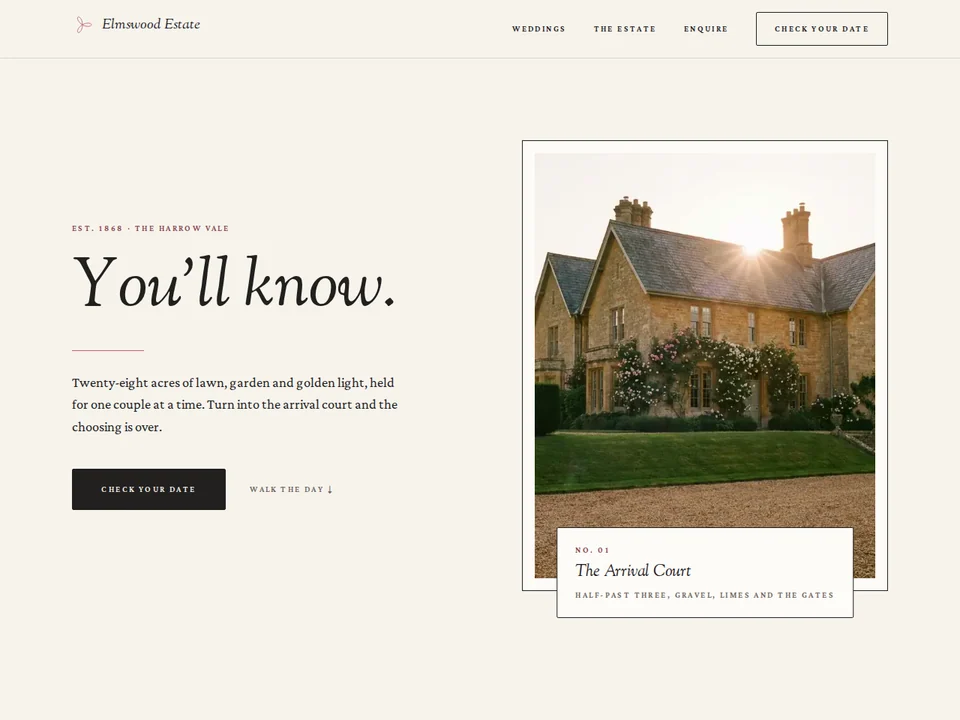
Want us to build Yours?
The kind of site people screenshot and send to their web guy. Tell us about the business, get an instant quote, and we build from your brief.